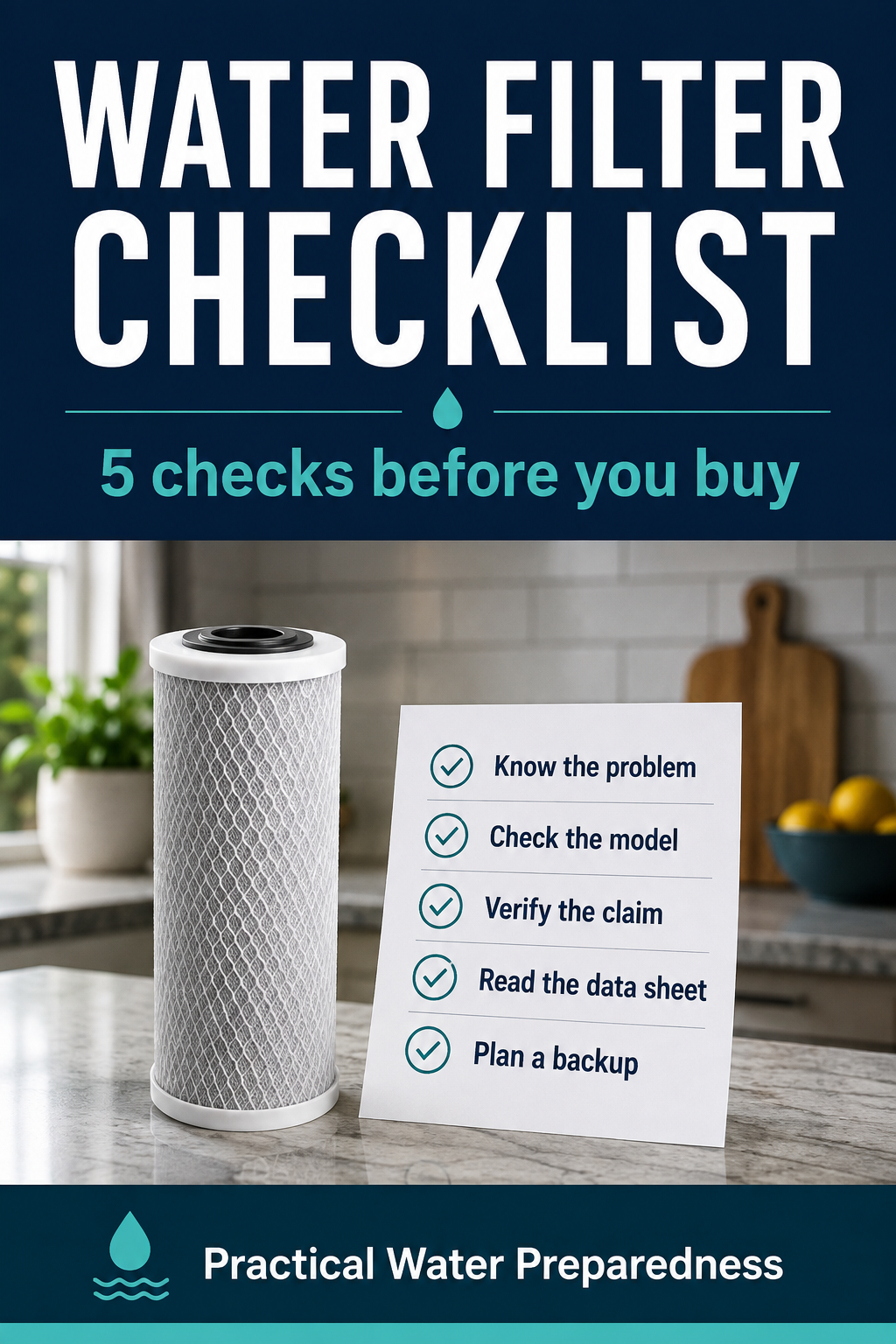
A filter is useful when its independently verified contaminant-reduction claim matches the actual problem. “Filtered” does not automatically mean safe for every use. Follow local instructions during any drinking-water advisory.
1. Identify the situation first
Are you addressing taste and odor in treated tap water, a contaminant identified by testing, a boil-water advisory, a do-not-drink or do-not-use notice, or untreated outdoor water? These situations are not interchangeable.
A chlorine-taste filter is not automatically a lead filter. A lead-reduction claim is not automatically a microbiological purification claim. Neither clear appearance nor better taste proves safety.
2. Understand the certification numbers
These numbers are not rankings. Certification covers specific claims for a specific model—not every contaminant mentioned in a standard.
- NSF/ANSI 42: aesthetic claims such as chlorine taste and odor.
- NSF/ANSI 53: specific health-effect contaminant claims.
- NSF/ANSI 58: reverse-osmosis systems and their certified claims.
- NSF/ANSI 401: certain emerging-compound reduction claims.
- NSF/ANSI 244 and NSF P231: different microbiological treatment applications. Check source-water limits and the exact claims.
3. Read the performance data
Find the exact model, certification organization, named contaminant-reduction claims, rated capacity, flow rate, source-water conditions, temperature and pressure limits, and replacement instructions. A micron number alone does not answer all of these questions.
4. Filtering does not cancel a boil-water advisory
CDC says to boil tap water during a boil-water advisory even after it passes through a home filter or filtering pitcher. Use commercially bottled water or bring water to a rolling boil for one minute—three minutes above 6,500 feet—and let it cool before use. Follow the instructions issued for your location.
A do-not-drink or do-not-use advisory is different. Boiling water contaminated with harmful chemicals or toxins will not make it safe. Do not substitute a filter for official instructions.
5. Avoid these four assumptions
- “Clear means safe.” Many hazards are invisible.
- “Better taste means hazards are gone.” Taste reduction is not a health-related claim.
- “The micron number tells me everything.” It does not replace verified performance and operating limits.
- “Certified means it removes everything.” Check the exact listing and claim.
6. Five checks before buying
- Define the problem. Use a utility report, laboratory test, or emergency notice.
- Record the exact model. Similar-looking products may perform differently.
- Verify the claim. Check an accredited certifier’s official directory.
- Read the data sheet. Match capacity, flow, replacement needs, and operating limits to your household.
- Keep a backup. Store emergency water and keep suitable replacement supplies and printed instructions. Boiling is a backup only when appropriate for the hazard.
Build a layered household plan
Combine stored emergency water, treatment suited to the source and hazard, replacement supplies, and a way to receive local advisories. Ask: “What is this exact model independently verified to reduce, under what conditions, and does that match my water problem?”
Calculate your stored-water needsSources and important notice
The linked CDC guidance and NSF standards and product directory inform this guide. Reviewed September 5, 2026. This is general education, not a determination that any water source is safe. Follow your utility and public-health authorities. Agency and standards references do not endorse any commercial product.